

Are you a gym bunny, doing classes every week? Or out in the countryside, cycling every weekend? Or in the fast lane at the pool, splashing everyone with your front crawl? Doing all this and telling yourself it's protecting your bones?
I used to think exactly the same thing. It turned out I was wrong, and the reason why really surprised me.
If you read my story, you’ll have found out that for years before I was diagnosed with osteopenia, I was pretty much a ‘cardio queen’. With full gusto, I pounded the studio floor at my local gym several times a week.
I absolutely loved my Zumba, STEP, swimming and - best of all - SPIN. I would try to get to spin a couple of times a week. Pilates as well, if I could get booked in (it was always full!).
I totally believed that I was building both strong muscles and probably, if I’d bothered to think about it, strong bones. Bearing in mind, I was also doing heaps of hill hiking.
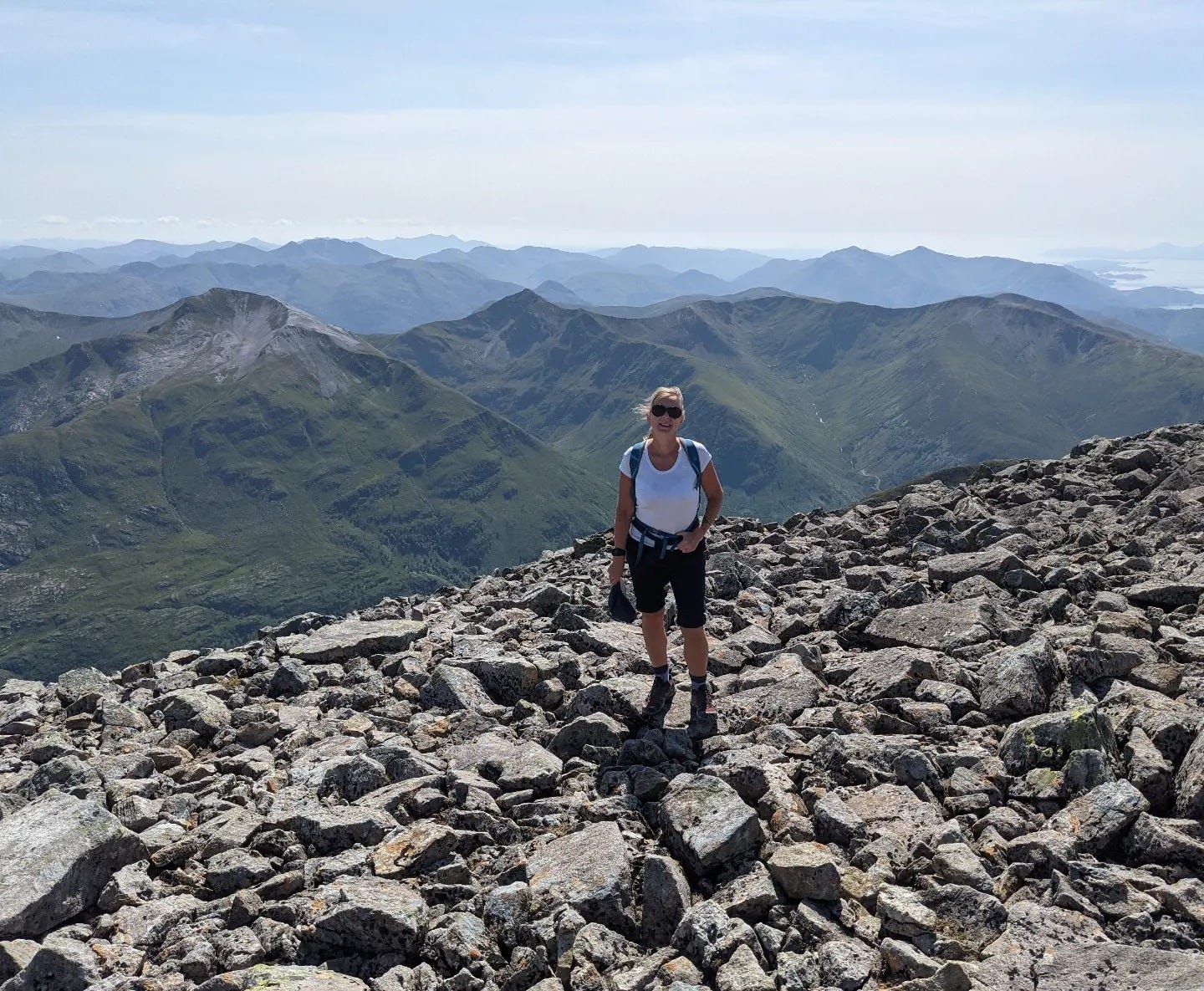
I was so fit that when I hiked up Ben Nevis in July 2021 it actually felt really easy. The photo heading this article is me at the top of Nevis. What a day!
This was all ‘weight-bearing’ exercise, wasn’t it? Well, as I found out - nope.
When ‘weight-bearing’ isn’t ‘weight-bearing’
I might have been bearing my own weight as I hiked up mountains or held an isometric Pilates move, but it wasn’t doing the job I believed it to be doing.
There is evidence to show that exercises like brisk walking, swimming, and jogging may help to limit bone loss, but such activities do not provide the mechanical load needed to stimulate bone tissue growth enough to combat accelerated loss.
Not that I got into fitness specifically to build bone. I mostly hadn’t thought about it, to be honest. Though I would do a little smug nod to the idea that I was exercising in a ‘bone-friendly’ way, whenever something came up in conversation, or whatever.
I actually got into fitness because I had begun working as a funeral celebrant. If there’s one thing that working in the funeral industry teaches you, it is that life can certainly be short. Especially if you don’t look after yourself.
What the dead can teach the living
Getting into funerals in 2017 was a bit of a wake-up call - “this could happen to you if you don’t start looking after yourself” is the message I was receiving. Loud and clear.
I wasn’t in the best of shape at that point in my life. I was overweight, and while I did enjoy walking (I always have, especially as I’ve always had dogs), and dancing too, I was definitely not ‘fit’.
I had met the man who became my husband just a couple of years previously, and we had LOVED food, and snacking. As well as beer and wine. I put on a few ‘happy in love’ pounds.
But in my funeral work, I was being repeatedly shown that poor lifestyles can equal early death. As a fairly consistent reminder, you’d have to be made of stone, or fully head-in-the-sand, to not take note.
Putting the work in
I got disciplined. I joined a local gym and started attending classes. I’ll never forget going to my first ‘Legs, Bums and Tums’ and, shamefully, had to leave the class after ten minutes because I was unable to keep up.
Even that ten minutes left me with three days of severe DOMS (delayed onset muscle soreness), too! Hard to believe I was ever like that now, as DOMS is a very rare occurrence for me, and only happens when I’ve had a training break.
But I persisted, and ultimately, I built a very strong cardiovascular system, along with amazing endurance for distance and hill walking.
What I didn’t realise was that it should have been only a part of my overall health routine. I had no idea at the time how important strength training was.
And because I had no idea, when it came to me getting my bone scan, part of me was convinced that I’d be told that I had nothing to worry about.
I was shocked with the report. I had osteopenia. What?
What I got wrong
Here’s the thing - cardio work builds your heart and lungs. That’s why it’s called cardio. It’s absolutely essential to a healthy active life, but it’s not the only thing we need.
There’s some impact included, but the body quickly adapts to the type of low-level impact provided.
Research shows us that bone needs impact, or to be heavily pulled against by the muscle (resistance), in order to grow new bone tissue.
Not only that, the stimulus has to keep changing - and be ‘continuously novel’. The stimulus should be in the form of mechanical load providing resistance.
Since some of the foundational theory on this was published, a stack of evidence-based literature through the years continues to support this.
Like anything though, you only know it if you know it. When I started out as a fitness newbie, I didn’t really understand that strength training was a necessity. Particularly as a woman in her early 40s.
Let’s face it, the fitness messages that we women generally receive - and only more recently has it started changing - are all about “do cardio, lose weight, punish yourself for eating the cake”. Am I right, or am I right?
I mean, there’s a whole article there in itself, and I shall probably get it written at some point, but suffice to say - it took an osteopenia diagnosis to get me to understand this.
So what did I do?
Well, if you’re new here and this is the first article you’ve read of mine, I’ll give you the good news - I turned my diagnosis around. My follow up scan 3.5 years later showed I had a significant increase in bone mineral density and that I had normal BMD again.
Because I embarked upon a dedicated strength training programme and was consistent with my new exercise routine, I had started to rebuild bone.
It was helped by changing my nutritional intake and also by lifestyle improvements, as well as HRT, but all the evidence points to it being the actual strength training that would have made the real difference.
The other aspects that I changed will certainly help to stabilise bone loss, or reduce the rate at which it is lost, but they are not alone usually enough to make a significant increase (which in my case, it was).
Some evidence shows HRT can help slow bone loss, and in some cases modestly increase density, but again, the studies show that targeted strength training is actually the thing needed to make a significant difference.
(Note: HRT is a personal decision to make with your GP or menopause specialist, not something I can advise on directly.)
Quick check: is your routine actually loading your bones?
If you can say yes to most of these, you’re likely on the right track. If not, it might be worth a rethink.
I include some form of resistance work, weights, bands, or progressively loaded bodyweight, not just cardio.
I’m working large muscle groups against actual resistance, not just holding a position or moving at a steady pace.
What I lift or the resistance I use has increased over the past few months, not stayed the same.
My routine changes regularly, rather than repeating the exact same pattern every session.
I could point to at least one exercise in my week that has felt challenging by the last couple of reps.
So, what does ‘targeted strength training’ look like?
Well, it can depend. It’s all relative to where you’re starting, and whether your body is always used to some patterns of exercise or not.
Resistance training is the umbrella term for training that involves the muscle pulling against a form of resistance, and therefore training both the muscle and stimulating the bone. Strength training is a form of progressive weight training that falls under this umbrella.
An effective strength training programme involves several exercises that will load your muscles on a total-body basis, done in 30-45 minute sessions, two to three times a week.
The focus should be on loading the whole body, exercises that work the posterior chain (back, glutes, legs), chest, hips, shoulders and arms.
Your focus should be on progressive overload - lifting or loading weights that increasingly get heavier the stronger you become.
For beginners, this may even be starting with simple bodyweight exercises or even some isometric holds - I have a 4 Week Bone Foundations Programme which is perfect for those who are new to this.
I hope you found this article useful, and has given you some awareness of how bone-friendly your own exercise-routine currently is. Please let me know?
Before you go:
Whether you are an individual or an organisation, if health and wellness is important to you, then please subscribe here for free. Expect a weekly, informative article along my themes of strong backs, strong bones, strong muscles - and follow me for notes with useful daily tips.
Please leave a comment:
I really want to hear from you. What did you think of this article? Was it relevant to you? Was it helpful? Please don’t go without leaving a comment - I’d like to get to know my readers better!
Share for rewards:
I have recently set up a reward scheme for referrals! Freebies at different tiers when you share! Please participate and start sharing Becoming Unbreakable to gather referrals for rewards (the first tier needs only 2 referrals!).
Disclaimer:
This content is for educational purposes only and isn’t a substitute for medical advice. I am not a clinician. Please check with your doctor before trying new exercises or taking health advice on this page; especially if you have osteoporosis, a diagnosed condition, or any concerns about your health.
This was really informative. I found the distinction between helping prevent bone loss and actually stimulating new bone growth especially interesting. Thanks for sharing!
Great article. Thanks :)