


In Part 1, we looked at the fear of getting bulky. In Part 2, the habit of stretching an achy back. This week, it’s perhaps the most deeply held myth of all, certainly among women: that thinner means healthier.
Like many women, I have spent years yo-yo dieting on one weight-loss regimen or another. As a journalist, I used to write for diet magazines like Weight Watchers and Slimming World, and I’ve followed every diet going myself.
Feel Like Becoming Unbreakable? Start Here.

Welcome to Becoming Unbreakable. I’m Andrea. In a moment, I’ll tell you my story of how I became unbreakable. Before I do, if you would like to become unbreakable too, please subscribe for here and receive my free gift of a guide on how to engage your core:
Invariably, as time wore on, my weight would creep back up. I’d blame myself, eat more for a while, then try another diet.
My goal in life was to be as thin as possible. I only managed it for short bursts, but I was on never ending diets. Plus, I had an extremely unhealthy relationship with food. That’s a story for another article.
This one is about how the belief that ‘being thinner is always healthier’ can cost women. Specifically, their bone health.
I ended up with osteopenia, which is low bone density. There’s good evidence that repeated dieting and under-eating can take a toll on bone. I believe years of crash diets and poor nutrition may have played a part in my bone loss, among other factors.
Let me be clear, though: I’m not saying weight doesn’t matter, because it does. Actually, let’s name it: excess fat, rather than ‘weight’.
A healthy ‘weight’ is good for your heart, your joints and your bones. But ‘healthy’ and ‘as thin as possible’ are not the same thing.
Why thin seems like healthy
It’s easy to see why we treat ‘thin’ and ‘healthy’ as the same. Decades of social conditioning and diet culture has convinced us that it must be so.
When we lose weight, friends tell us how great we look because we shed a few pounds. We may get “Oooh you look sooo trim” but we will never get “oooh, you look like you have strong bones.”
Newspapers and magazines report on the weight loss and weight gain stories of celebrities (usually women) as if it actually matters. Social media influencers share their ‘thinspiration’, posting filtered bikini shots while sipping a green smoothie. From the outside, it looks like a healthy lifestyle.
The fitness industry doesn’t help, either. Much of it relies on people’s insecurities about weight for business, so you see programmes galore built on extreme weight loss regimes promoted as a health ideal. They advertise ‘12 week transformations’ with before and after pictures of successful clients.
What they don’t show is how many people regain the weight, or more, afterwards. The evidence is fairly established. On average, more than half of lost weight is regained within two years, and more than 80% by five years (Hall & Kahan, 2018).
There are many reasons for this, but what matters for this article is that people often end up in perpetual cycles of losing and gaining weight. Like being too thin, this yo-yo cycle is also not healthy.
Shall we look at the evidence?
I want to be clear that this isn’t about thin-shaming, nor, of course, is it about fat-shaming. I’m just here to share the facts.
One of the biggest health risks for older women is osteoporosis. One in two women over 50 will break a bone because of it (Bone Health & Osteoporosis Foundation). And among older women, it’s the thinnest who are most at risk, compared with their peers of a normal weight.
According to Harvey et al. (2025), underweight women had more than twice the risk of hip fracture compared with women of a healthy weight. Part of that was down to thinner bones.
But even when the researchers compared women with the same bone density, the underweight women were still around 70% more likely to break a hip. Being underweight was also linked to higher death rates.
A large study of almost 60,000 people found that a BMI of 20 carried almost twice the risk of hip fracture of a BMI of 25 (De Laet et al., 2005). The risk rose most sharply at the low end of the BMI scale.
Does this mean people with obesity have stronger bones? They tend to have higher bone density, partly because of the extra load their skeleton carries. But obesity does not protect against fracture. Rather, it changes where fractures happen.
Compston et al. (2011) found that women with obesity had more ankle and upper leg fractures, though fewer wrist fractures.
Another interesting piece of the puzzle comes from a study of heart health. Srikanthan et al. (2021) found that women with high muscle mass and higher body fat had a 42% lower risk of dying from heart disease than women with low muscle and low fat.
What this research points to is the protective power of muscle, which is much harder to build when you’re focused on staying thin. The aim is a healthy weight (not too thin, not carrying too much body fat) and then to train for strength and muscle.
So what is a healthy weight?
We all need some fat. It does several jobs, and for women that includes helping to regulate hormones. What matters is how much fat we carry compared with lean tissue, not how big or small the number on the scales is.
That’s especially true once we start strength training, because the number on the scales may not change much, or may even go up, while body fat comes down. One of my former PT clients dropped two dress sizes without the scales budging. The scales can be very deceptive!
Most of us don’t have access to a DEXA scan, which can measure fat and lean mass fairly accurately. Therefore, a good, accessible indicator is your waist.
NICE advises adults with a BMI under 35 to keep their waist to less than half their height. So if you’re 5ft 4in (64 inches), aim for a waist under 32 inches. Measure halfway between your lowest rib and the top of your hip bone.
The NHS has a handy calculator tool.
Most health and fitness professionals now recognise BMI (body mass index) as a crude tool. It can’t account for body composition, and I’ve known people with very muscular, lean physiques who still register a high BMI, because muscle is denser than fat.
So take BMI with a pinch of salt, and check your waist.
Lose weight slowly to lose weight safely
The diet and fitness industries never say “Lose weight responsibly” the way the alcohol industry has to say “Please drink responsibly.”
Helping people manage their weight, where needed, is part of a PT’s remit. But because everyone loves a quick fix, many PTs are under pressure to get fast results with clients, and that isn’t always the best option.
The Royal Osteoporosis Society says that “A restricted calorie diet may reduce bone strength.” It adds that “If you lose weight rapidly, up to a third of the weight you lose will be lean mass.”
Lean mass is largely muscle. So along with the fat we’re so keen to lose, rapid weight loss can strip away our much-needed metabolic engine: our muscle.
A meta-analysis of diet trials found that diet-induced weight loss reduced hip bone density over 6 to 24 months, although the spine wasn’t significantly affected (Zibellini et al., 2015). The authors called the loss small compared with the metabolic benefits for people with obesity.
The arrival of GLP-1 weight-loss injections muddies the waters further. I’m not against them, but the weight loss they bring can be very fast.
A 2024 trial of people on a weight-loss injection found that those who exercised alongside the drug did better for bone than those on the drug alone (Jensen et al., 2024). That means anyone using them should combine their treatment with exercise, particularly strength training, to protect muscle and bone.
The message here is not “Don’t lose weight.” It’s “if you need to lose weight, do it while protecting your bones and muscles”.
Strong, not small
So what does protect our muscles and bones? The answer is given through this whole series: strength training.
In one trial, older adults with obesity lost around 9% of their body weight over six months. Those who did only cardio lost 2.6% of their hip bone density. Those who lifted weights lost just 0.7% (Armamento-Villareal et al., 2020). Same weight loss, but very different result for their bones.
For women, timing matters too. Bone loss speeds up from about a year before the final menstrual period which marks menopause, at roughly 2% a year for about three years (Greendale et al., 2012). Crash dieting in midlife piles more loss on top, at the worst possible time.
So if you’re losing weight, or thinking about it:
Do total body strength training two to three times a week.
Aim for slow, steady loss rather than rapid drops.
Eat enough, with 20-30g of protein at every meal.
Keep walking for your heart and mood, but don’t rely on it for your bones.
On weight-loss injections? Ask your doctor about your bone health.
For anything specific about how much to eat, supplements or medication, speak to your doctor or a registered dietitian.
Quick healthy weight check:
1. Check your BMI
Use the NHS BMI calculator. Remember that it’s a rough guide, because it can’t tell muscle from fat, but it can tell you if you’re underweight (a BMI under 18.5).
2. Check your waist
Use the NHS waist-to-height calculator. Aim to keep your waist to less than half your height. This tells you if you’re carrying too much fat around your middle, which BMI can miss.
3. Why you need both
The NHS doesn’t indicate what a waist that would be too small is, the waist-to-height guidance only tells you when your waist is too big. So a small waist on its own doesn’t prove you’re healthy, and a “healthy” BMI doesn’t rule out excess fat around your middle.
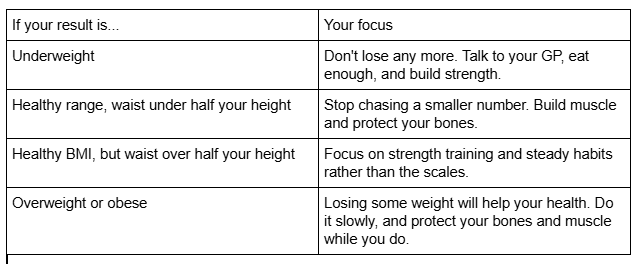
Use BMI to check you’re not underweight, and your waist to check you’re not carrying too much around your middle.
Putting the two together:
The NHS tools aren’t suitable for everyone, so check the guidance on each page first. For example, the waist calculator isn’t for use if you’re pregnant, have a BMI over 35, or have, or think you may have, an eating disorder.
If any of these sound familiar, or food and weight have been a struggle for you, your GP is a good first step.
Want to become unbreakable?
Exciting news!
Coming in early 2027 is my 8 week course, Become Unbreakable: Future-proofing Your Body for Women After 40. No obligation to be on the course by joining the early bird waitlist, but if you decide it’s for you when the time comes, you’ll be eligible for my early bird offers and bonuses!
References
Armamento-Villareal R, Aguirre L, Waters DL, et al. Effect of aerobic or resistance exercise, or both, on bone mineral density and bone metabolism in obese older adults while dieting: a randomized controlled trial. Journal of Bone and Mineral Research. 2020;35(3):430-439. doi:10.1002/jbmr.3905
Compston JE, Watts NB, Chapurlat R, et al. Obesity is not protective against fracture in postmenopausal women: GLOW. American Journal of Medicine. 2011;124(11):1043-1050. doi:10.1016/j.amjmed.2011.06.013
De Laet C, Kanis JA, Odén A, et al. Body mass index as a predictor of fracture risk: a meta-analysis. Osteoporosis International. 2005;16(11):1330-1338. doi:10.1007/s00198-005-1863-y
Greendale GA, Sowers M, Han W, et al. Bone mineral density loss in relation to the final menstrual period in a multiethnic cohort: results from the Study of Women’s Health Across the Nation (SWAN). Journal of Bone and Mineral Research. 2012;27(1):111-118.
Hall KD, Kahan S. Maintenance of lost weight and long-term management of obesity. Medical Clinics of North America. 2018;102(1):183-197. doi:10.1016/j.mcna.2017.08.012
Harvey NC, Johansson H, McCloskey EV, et al. Body mass index and subsequent fracture risk: a meta-analysis to update FRAX. Journal of Bone and Mineral Research. 2025;40(10):1144-1155. doi:10.1093/jbmr/zjaf091
Jensen SBK, Sørensen V, Sandsdal RM, et al. Bone health after exercise alone, GLP-1 receptor agonist treatment, or combination treatment: a secondary analysis of a randomized clinical trial. JAMA Network Open. 2024;7(6):e2416775. doi:10.1001/jamanetworkopen.2024.16775
National Institute for Health and Care Excellence (NICE). Guidance on waist-to-height ratio for adults with a BMI under 35. nice.org.uk
Royal Osteoporosis Society. Risk factors for osteoporosis that you can change. theros.org.uk
Srikanthan P, Horwich TB, Calfon Press M, Gornbein J, Watson KE. Sex differences in the association of body composition and cardiovascular mortality. Journal of the American Heart Association. 2021;10:e017511. doi:10.1161/JAHA.120.017511
Zibellini J, Seimon RV, Lee CM, et al. Does diet-induced weight loss lead to bone loss in overweight or obese adults? A systematic review and meta-analysis of clinical trials. Journal of Bone and Mineral Research. 2015;30(12):2168-2178. doi:10.1002/jbmr.2564
Disclaimer:
This content is for educational purposes and isn’t a substitute for medical advice. I am not a clinician. Please check with your doctor before trying new exercises or taking health advice on this page; especially if you have osteoporosis, a diagnosed condition, or any concerns about your health.
“Oooh you look so trim” but never “you look like you have strong bones.” So true!! As a health coach I saw so many women chasing a smaller number on the scales. For me it was always the other way around. I struggled to keep weight on and not get too thin. Thin gets praised either way, but it doesn’t mean healthy. 😊
I used to believe that being really thin meant being healthy too. It’s taken time to understand that health is about so much more than the number on the scales. Building strength, nourishing our bodies, and finding a sustainable balance matter so much more than simply trying to be smaller. Such an important article and a reminder that we need to change the way we think about health.