

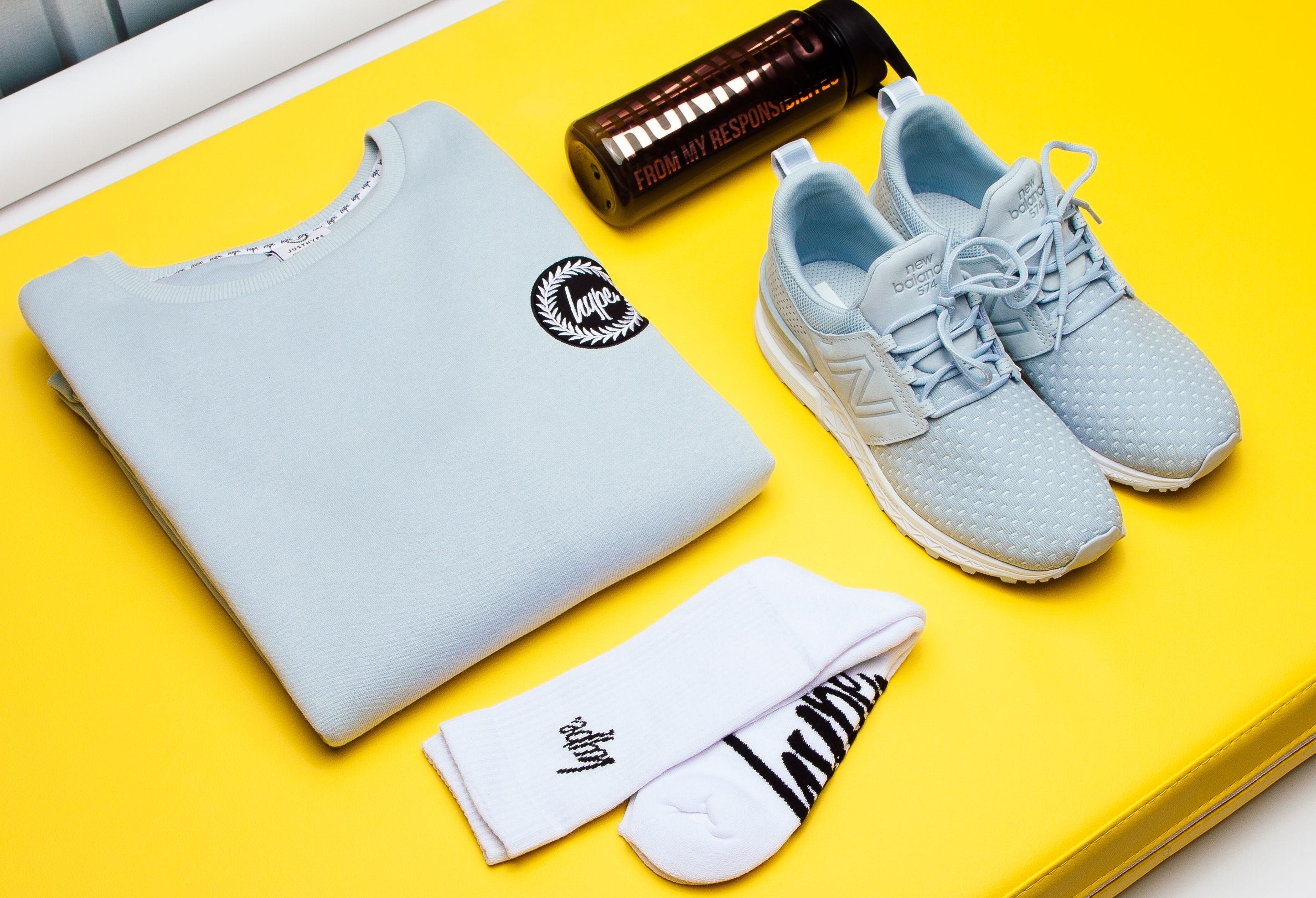
Monday has arrived and you promised yourself you would start at the gym today. You’ve packed your bag. Trainers and water bottle at the ready. You are definitely going today.
It’s now bedtime on Monday. Your bag is still there, waiting at the door. You found every reason in the world not to go.
Work was too hectic. The kids were too rowdy. TV was too compelling. Dog was too barky.
You’re down on yourself. You’d feel great now if you’d just gone.
You’ve started to notice the joint niggles from being unused. You’re getting out of breath quicker doing everything. Damn. Why didn’t you just go?
Okay. It’ll be tomorrow then. You’ll start tomorrow.
Guess what? You don’t. Is this a familiar story?
Well, it is to me. I’ve been there and done that, several times over. Being a personal trainer does not exempt me from being a normal human being.
Often, I think the rest of the world imagines that personal trainers have some superpower that swings them to the gym even when they’re sweating from flu and their goldfish has just died.
And with a smile on their face.
Okay, I think there are a few like that. They love being in the gym more than they love Netflix or eating out or seeing friends or pretty much anything else. Training several hours a day is their bag.
But most of us are not like that.
The point is that people often compare their beginning with somebody else’s extreme end point, and conclude that fitness isn’t for them.
It’s a perception that is holding a lot of people back.
The barriers we face:
Before I got started in fitness, it took me years to get started in fitness.
I didn’t identify myself as someone who loved exercise. I had a pretty shoddy time during my PE years at school. Always the last picked for any team. I never felt like I achieved anything in sport.
These old experiences have a habit of staying with you.
But for all of us - and you’re likely reading this because somewhere, for the sake of your health, you feel you have to do something about your fitness - there comes a time when we know we have to change things.
If only we could get motivated.
But part of the problem is that we’re relying on ‘motivation’ to do the trick.
Let’s first look at some of the barriers that can get in the way, then come back to why motivation isn’t necessarily what we should be relying on.
A meta-review by Vasudevan and Ford (2021), looking at barriers to strength training in women, found that some of the most common included gender-related stigma and fear of negative comments based on gender.
Another commonly cited barrier is a lack of knowledge around strength training.
People simply don’t know where to start, which is exactly why I’ve built structured plans and a beginner programme into what I offer here.
Certainly, from what I have seen in comments on my feed, this seems to be the case.
I used to be in that same position. When I was a journalist, I spent hours a day at my desk and relied on gel wrist supports, soft cushions and ibuprofen to see me through the day with a gnawing back and RSI (repetitive strain injury).
I actually didn’t know at that point that there was another way.
I was very unfit. I only really walked my dog for exercise, and did some weekend dancing - accompanied by copious wine.
The belief I held that “I don’t do exercise” also underpinned my inability to see exercise as a possible solution to my problems.
My self-belief was a barrier.
People also might be concerned about risk factors around exercise. A 2017 study by Burton et al found that older people are worried they could be at risk of a heart attack or stroke, rather than viewing exercise as something that will reduce the risk.
Likewise, in comments from my readers, injuries or conditions that cause pain, or previously caused pain, may be a barrier. This might be a real concern, or a perceived concern.
One reader said: “I have permanent injuries from a car accident and have only felt comfortable using small weights, my own weight, and resistance bands. The fear of further injury and triggering pain...is the major reason for taking 5 years to even begin strength training again.”
When people have genuine pain or an existing condition, exercise needs to be approached carefully and progressively. In some cases, it may get worse before it gets better, like with sciatica, for example, which I wrote about recently.
That’s one reason I’m so keen on people getting appropriate guidance rather than simply throwing themselves into a programme.
Confidence - wherever it results from - is often a major obstacle, too.
I was actually petrified of going into the weights room at the gym when I first started. And that was even after I first qualified as a PT, which is when I started strength training.
So. I absolutely get it.
If me, a newbie PT, felt nervous about entering the sweaty domain of the bodybuilder, how on earth is someone who has no training and is unsure about what they are doing supposed to feel?
The tricky thing about confidence is that you only gain it after you start doing the thing that will grow your confidence.
What you need to become confident is courage.
Strength training in midlife is very important for us to create the best conditions for ongoing wellness and longevity, so whatever the barriers you face, how can you make it happen?
Say goodbye to the motivation mantra:
I know everyone loves a good motivational quote, but when it comes to fitness, waiting for motivation to strike is not the answer.
The issue is, your brain does a cost-benefit analysis of every action, and you can be equally motivated not to exercise, as Dr Ian Taylor from Loughborough University explains perfectly.
For example, you can be motivated to stay on the comfortable sofa.
You also may never feel ‘ready’.
And while you’re waiting, your body is hoping for some help. It needs you to take a different approach, and throw it a bone (excuse the pun, seeing as I often talk about bone health here).
The answer is to create a new habit, and then become disciplined about making it a regular thing. It takes time and effort. But it’s completely doable.
Honestly. For pretty much every excuse or barrier that exists - whether real or perceived - I have been there at some time.
Sometimes I still am, but I have a long-term habit now.
I also know and feel the benefits of exercise, and they encourage me to stay on track. In my experience, I don’t think I’d have been able to reverse my osteopenia without strength training.
So yes. Let’s forget about ‘motivation’, and instead, build a system.
Excellent recommended reading on systematic habit forming is Atomic Habits by James Clear - an absolute belter of a book which rewrites what we think we know about habit creation, and gives excellent practical tips to create new ones.
A very powerful tip from James is associating cues with a new habit.
For example, for most people, when we go to bed, we brush our teeth. The action of going to bed is the cue to signal it’s time to brush our teeth.
This habit is so ingrained that we barely think about it. This is where we need to eventually get to with exercise and strength training.
For example: “It’s Sunday morning. I have coffee, then I do a 30-minute strength workout.”
It takes time to practise, but as you start to do the habit more often than you don’t, it will start to feel weird when you don’t.
Reframe the barriers:
You first have to get over those pesky barriers though, don’t you?
I’ve run the gamut of excuses. I’m not a machine.
And I’ve heard them all with my clients, too. I used to ask them to find ways around them - because deep down, we both knew they wanted to change their health.
We know that you do, too, otherwise you wouldn’t be reading this.
You have to be brave, because only you can do it for you.
Have a little look at the table below. Which do you own?
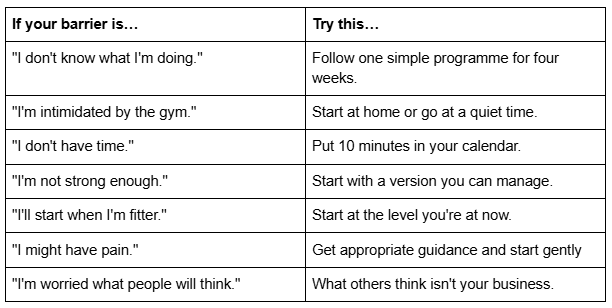
Save this article so you can come back to this table and refer to it when that little voice strikes.
Set yourself up for success:
Once you have worked on reframing your barriers, you need to have a plan to start, and it needs to be one which gives you the highest chance of success.
If you absolutely know that starting the gym on a Monday is a tough call because work is so busy and you have to take the kids swimming and you need to clean the house and so on - then don’t set yourself up for failure by trying to squeeze in some training, too.
Interestingly, one study from Dai et al (2014) said that people are more likely to adhere to an exercise programme at the start of a new week.
For me, my weekends tend to be quieter.
But I also see training as something that is my leisure time - not a chore. I see it as ‘me time’, and Sunday for me is generally a great day to fit a session in.
For some people, going to the gym on the way home from work is best. If they go home first, they will flop in front of the TV instead.
Here’s a few more tips on how to set yourself up for success:
Find a day and time to start when you know you have a definite slot. Tuesday 6pm straight after work, for example.
Get your kit ready several hours earlier or the day before - this stops rushing from being your reason not to go.
Be the designated driver more often. Experience shows that hangovers are a key reason in not adhering to fitness goals (obviously talking about my PT clients, not myself, hah!).
Keep telling yourself “I’m doing something good for me”. It is not punishment, it’s physical nourishment.
Start SMALL. I can’t stress this enough. Plan for even 10 or 15 minutes of bodyweight exercises at home once or twice a week to begin, if that is what feels doable.
Remember that strong isn’t something you are, it’s something you deliberately become. You don’t get there overnight, and that is perfectly okay.
But the sooner you begin, the sooner you will start feeling the benefits.
Here’s your challenge: don’t wait for Monday;
Pick one 10-minute session you can realistically do this week. Put it in your calendar. Put your clothes out beforehand.
And when the time comes, don’t ask yourself whether you feel motivated.
Just begin.
Before you go:
Whether you are an individual or an organisation, if health and wellness is important to you, then please subscribe here for free. Expect a weekly, informative article along my themes of strong backs, strong bones, strong muscles:
Share the love:
If you know someone else who will benefit from this publication and the wealth of information that I provide here, please do share:
Disclaimer:
This content is for educational purposes and isn’t a substitute for medical advice. I am not a clinician. Please check with your doctor before trying new exercises or taking health advice on this page; especially if you have osteoporosis, a diagnosed condition, or any concerns about your health.